

Most banks wait. They watch a new payment form factor for a few years, commission some research, run a small pilot with a controlled customer group, and eventually issue a cautious press release once someone else has proved the market.
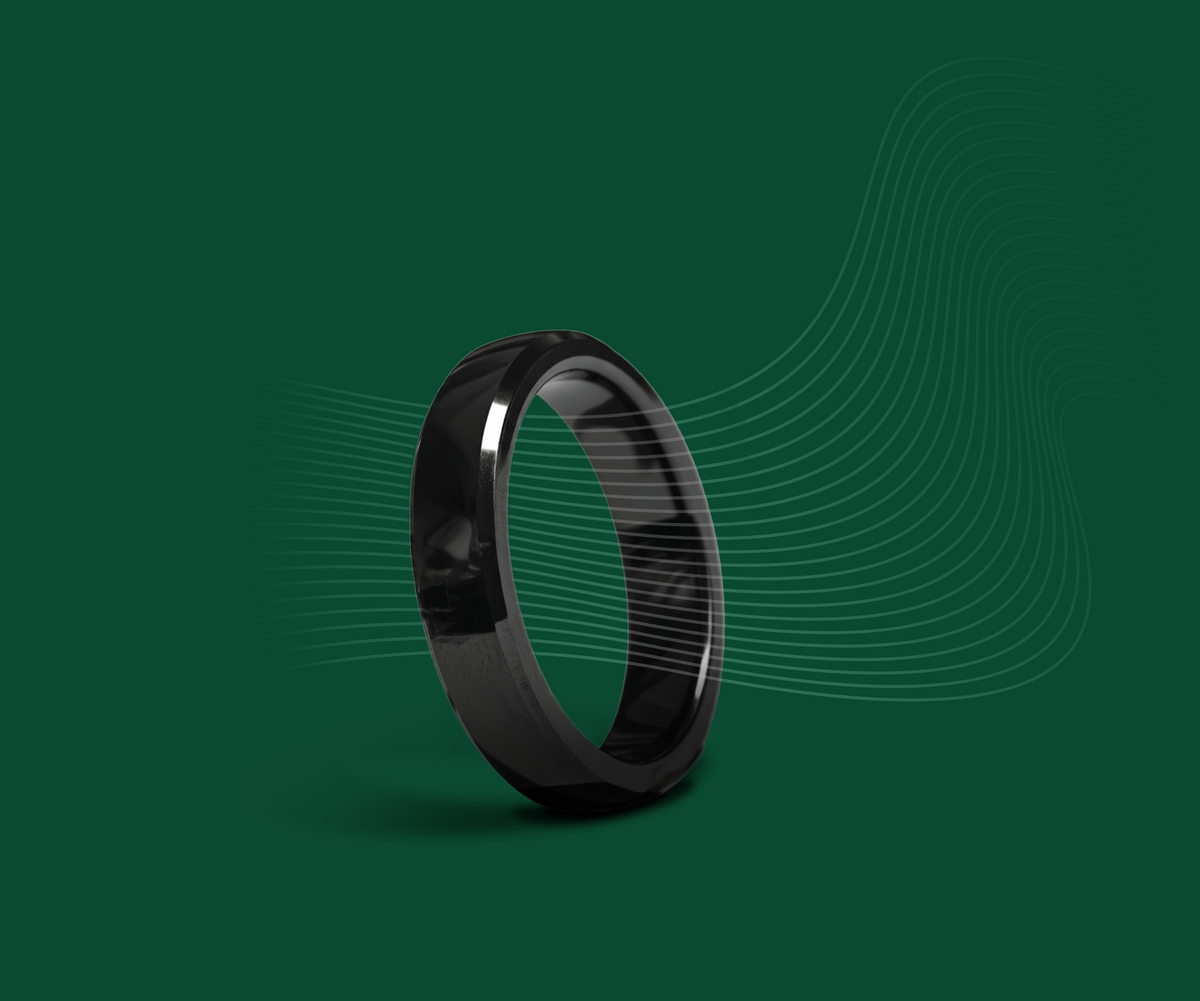
CIB Bank did not wait. Between 15 July and 30 September 2026, the bank has been running a customer acquisition campaign in which people opening a CIB ECO, ECO Plusz or ECO For You account with a Visa Inspire debit card, and meeting the promotion's conditions, receive a coupon for a black RingPay payment ring, a product with a retail value of 31,900 forints.
Read that again, because the detail matters. This is not a banner advert. It is not an innovation lab experiment. CIB Bank has placed a payment ring at the centre of a mainstream current account acquisition campaign, alongside Visa, in a national market. The wearable is not a footnote to the offer. The wearable is the offer.
We are the company that makes the ring, so we are not neutral. But we would like to explain why we think this campaign deserves rather more attention than it has received, and why it says something important about where Hungarian payments are heading.
CIB Bank read the demand correctly
The campaign is built on research commissioned by CIB Bank and Visa which found that more than half of Hungarians aged 18 to 35 would be willing to try a payment ring, and that more than a third of those aged 27 to 35 have already used some form of wearable payment device.
Those are striking numbers. They describe a market that has moved past curiosity and into expectation. Young adults in Hungary have already made the jump from card to phone. The jump from phone to object is a smaller one than the industry assumes, because the underlying behaviour — hold your hand near the terminal — is identical. Only the object changes.
CIB Bank's Fodor Dalma, who leads retail transactional products, has framed the campaign as bringing ring payments closer to young adults, and building on an openness that the data already shows exists. Visa's Katalin Juhász has spoken about the pride of making the solution available to Hungarian consumers alongside CIB.
What we would add is this: plenty of banks commission research like that, read the same result, and file it. Acting on it is the difficult part, because a wearable in an acquisition campaign carries operational consequences. It requires sizing, fulfilment, an app pairing journey, customer service scripts and clear lines of responsibility between the bank and the device provider. CIB Bank did that work. That is what forward thinking actually looks like in retail banking. It is rarely a keynote. It is usually a lot of unglamorous internal groundwork by people willing to carry the risk of going first.
Where the ring came from is not where you would expect
Here is the part of the story that most coverage has understandably missed.
RingPay is not the output of a consumer electronics startup. It comes from Money Carer Group, a British social enterprise founded in 2009 whose day-to-day work is managing money on behalf of vulnerable adults — people with learning disabilities, dementia, acquired brain injury and other support needs. We operate corporate appointeeship, deputyship and everyday money management services under the oversight of the Office of the Public Guardian and the Department for Work and Pensions.
We did not enter the wearables market looking for a consumer trend. We entered it because our clients could not use the payment tools the industry had built for them. A PIN is a barrier if you cannot reliably recall four digits. A card is a barrier if you cannot keep hold of it. A phone-based wallet is a barrier if you do not own a smartphone or cannot navigate one. Each of those barriers ends the same way, with someone dependent on another person to hand them cash and account for it afterwards. That is a loss of dignity, and it is entirely a design failure.
So we built payment wearables that solve it: a ring with no battery, no screen, no charging cable and no app dependency at the point of payment. It works anywhere Visa contactless is accepted, worldwide. It is waterproof, needs no internet connection, and is always ready.
The same principles produced the Touch Account, launched in June 2026 as the UK's first PIN-free inclusive bank account, with Circle of Care support controls, spending limits, a biometric card and FSCS protection to £120,000. Our work is grounded in the Mental Capacity Act 2005 and Article 12 of the UN Convention on the Rights of Persons with Disabilities, which affirms that disabled people hold legal capacity on an equal basis with everyone else. This year the business has been shortlisted at PAY360 2026 for Best Initiative in Financial Inclusion and ESG, and for the Disability Inclusion Award.
That heritage is not a corporate social responsibility page bolted onto a gadget company. It is the reason the product is the shape it is.
Accessibility engineering is just good engineering
There is a lesson here that the payments industry keeps having to relearn.
The reason a Hungarian 24-year-old at a festival wants a ring that never needs charging is precisely the reason a person with dementia in Warrington needs one. Neither of them should have to remember to plug in their means of payment. The requirement that came from the most constrained user turned out to be the requirement that the mass market wanted all along.
This is the kerb-cut effect, and it runs through the whole history of technology. Design for the person the system currently excludes, and you almost always end up with something better for everyone. What CIB Bank and Visa have done is take a device born of financial inclusion work and put it in front of hundreds of thousands of ordinary current account customers, without needing to make a fuss about its origins. That is inclusion succeeding on its merits rather than on sympathy, which is the only way it ever really succeeds.
Why this matters for the direction of Hungarian payments
Hungary has been quietly ahead for some time — instant payments infrastructure, high contactless penetration, an unusually digital retail banking population. What this campaign adds is a shift in the unit of innovation.
For fifteen years, payment innovation has meant putting more into the phone. Every roadmap converged on the same rectangle. The wearable moves in the opposite direction: it takes the payment credential out of the general-purpose device and puts it into a specific, single-purpose object that you were going to be wearing anyway. Security tokenisation means the card details never sit on the ring itself, only a token that is worthless to anyone who finds it, and our tokenisation partner Fidesmo handles that layer.
That change has consequences that go well beyond convenience. It decouples payment from screen access, from battery life, from operating system politics and from app store gatekeeping. For a bank, it is a route to a customer relationship that does not run through a handset manufacturer's wallet. For a country, it is an opening into a category — payment jewellery, payment clothing, payment accessories — that nobody has yet defined.
CIB Bank, part of the Intesa Sanpaolo group, has effectively made Hungary the reference market for that idea. When the campaign closes on 30 September, there will be a large cohort of Hungarian consumers with a working payment ring on their finger and no particular sense that they are doing anything exotic. Normalisation is how categories are actually created. Not launches. Habit.
Credit where it is due
It is easy to applaud innovation once it is safe. It is harder, and rarer, to applaud the institution that moved before it was.
CIB Bank and Visa Hungary looked at a payment ring made by a British social enterprise, judged the demand data credible, and put their own brand, budget and customer acquisition strategy behind it. That took conviction, and internal advocates who were prepared to argue for it.
We are proud that a product built for people the payments industry has spent decades overlooking is now the centrepiece of a mainstream Hungarian banking campaign. And we are grateful to a bank that was willing to be first.
Share:
The Thinking Person's Payment Ring
Forget Your Phone at the Checkout: Hungarians Are Paying with Rings