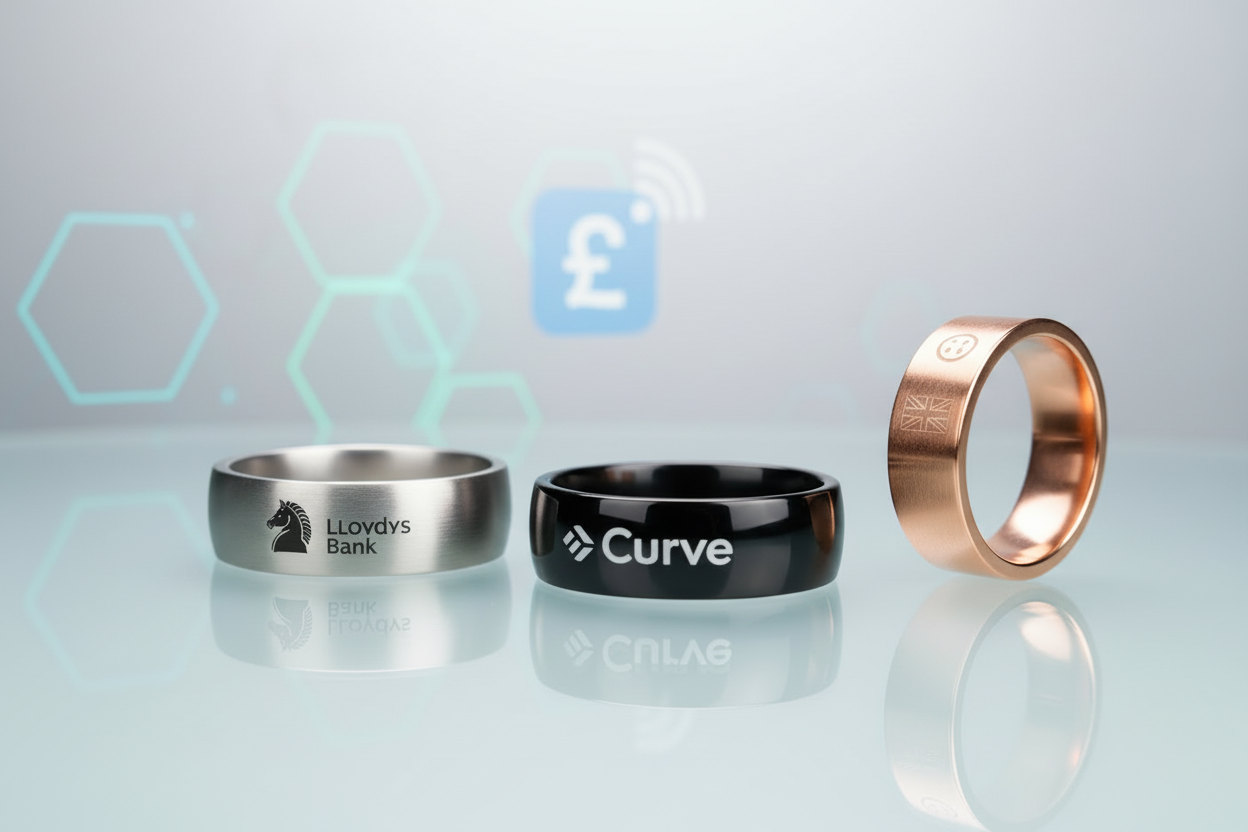
Lloyds Banking Group announced its acquiring Curve — the “one card to rule them all” fintech that sits between your funding cards and the payment networks, and that has quietly become critical plumbing for a growing number of payment wearables.
To most people, that headline sounds like another bank gobbling up another fintech. To the wearables world — rings, bands, key fobs, “tap-to-pay” accessories, and the niche wallets that power them — it could feel more like a sudden change in gravity.
Because Curve isn’t just a consumer brand. It’s connective tissue.
Curve’s hidden role: a bridge for wearable payments
Most wearable distributors just want connectivity for their retail customers who just want the same. Although for some the set-up process can be a bit clunky, the consumer gets from A to B.
In many setups, Curve is effectively the “issuer layer” or compatibility layer that lets a wearable present itself as a contactless Mastercard (or similar credential), while letting the user choose which underlying card actually gets charged. Wearables that tout “use any of your existing cards” often rely on a bridge like this.
If a major UK bank buys that bridge, the wearable ecosystem has to ask a blunt question:
Does Curve remain neutral infrastructure — or become bank strategy?
Why Lloyds would want Curve (strategically, not nostalgically)
From Lloyds’ perspective, Curve offers three tantalising assets:
-
A consumer-facing super-aggregator that can sit on top of any card relationship — including competitors.
-
A distribution channel into “tap” moments: everyday spending, default-card selection, and high-frequency engagement.
-
A wearable-ready stack that’s already navigated the ugly intersection of tokenisation, device provisioning, and scheme compliance.
Banks have long wanted to be the default payment choice on devices. Curve is one of the few things that can influence default behaviour without owning the underlying card.
Buying Curve would let Lloyds compete for “top-of-wallet” without needing to win every primary banking relationship. In a world where attention is scarce and payments are commoditised, controlling the switch is almost as powerful as controlling the account.
The immediate worry for wearables: neutrality risk
Wearables companies that rely on Curve connectivity generally need stability more than they need hype. Their nightmare isn’t “competition.” It’s:
-
a pricing change,
-
an API change,
-
a compliance re-interpretation,
-
or a strategic pivot that turns their dependency into a bargaining chip.
If Curve becomes part of a large bank, there are a few ways neutrality could erode — even if everyone insists it won’t.
1) Commercial terms could drift upward
Banks are good at one thing: being paid for risk and distribution.
Curve-as-a-fintech might price partnerships to grow the footprint. Curve-as-a-bank-asset might price partnerships to optimise return on capital, risk, and brand alignment. Wearable programs could face higher per-active-user fees, tighter minimum guarantees, or more expensive compliance obligations passed through contractually.
2) “Soft exclusivity” becomes the default
Nobody has to announce, “competitors not welcome.” It can happen via:
-
slower onboarding for non-aligned partners,
-
additional audit steps,
-
reduced product support,
-
or simply deprioritising roadmap items that help third-party wearables.
Wearables live and die by time-to-market. A two-quarter delay can kill a product line.
3) Feature throttling in the name of risk
Curve’s most attractive consumer features (think routing, switching, “smart rules”) are also the features that can trigger conservative risk instincts inside a bank.
Post-acquisition, Curve might keep the basics but become more cautious about the clever bits — especially if internal risk committees decide some functionality looks too much like “re-issuing” other banks’ cards, or too sensitive during fraud spikes.
That matters for wearables because wearables often use the clever bits to justify why their product isn’t “just a plastic card you can lose.”
The less obvious implication: wearable UX could improve — for some
It’s not all doom. If Lloyds really leaned in, an acquisition could unlock things fintech's struggle to do at scale.
1) Better fraud controls and provisioning success rates
Wearable provisioning can be finicky. Drop-off during setup is brutal. A bank-backed Curve could invest more in:
-
smoother KYC/KYB flows,
-
stronger risk engines,
-
and better issuer relationships (which often improves acceptance and stability).
If you’re a wearable brand constantly fighting “it won’t add my card” support tickets, bank-level investment might be a gift.
2) More mainstream distribution
Lloyds can put Curve-like functionality in front of millions of customers quickly — and with it, normalize wearable payments for audiences that currently think rings are “for crypto bros” or “for marathon people.”
That could expand the total market for wearables, even if it makes the infrastructure more controlled.
3) A UK payments champion narrative
A large UK bank owning a globally relevant payments wrapper could be pitched as building domestic capability in a space dominated by US processors and platform gatekeepers.
If the strategy is “make this a platform,” wearables could benefit — but only if platform economics stay platform-like.
The big question: does Curve become a platform or a product feature?
After any acquisition, corporate gravity pulls toward one of two futures:
A) Curve as a platform
Remain infrastructure-like. Keep partners. Grow ecosystem. Charge fairly. Avoid exclusivity. Invest in tooling.
B) Curve as a product feature
Fold into Lloyds’ app. Use connectivity to drive Lloyds primacy. Partners become “nice to have,” not “the business.”
Wearable companies should read the early signals:
-
Are partnership leaders retained and empowered?
-
Do partner roadmaps survive the first integration cycle?
-
Does pricing shift from per-use to “relationship-driven” deals?
-
Does Curve’s brand stay distinct or get subsumed?
Those aren’t press-release details. They’re tells.
What happens to wearable brands that depend on Curve?
If you’re a wearable program manager and Curve is your connectivity backbone, this hypothetical acquisition forces a few strategic moves — quickly.
1) Diversify your rails (even if it hurts)
The best time to build a second route is before you need it. Dual-sourcing payments infrastructure is painful, but not as painful as being stuck mid-contract renewal with one supplier that just gained new leverage.
Wearables may start pursuing:
-
alternative issuer-processors,
-
region-specific issuing partners,
-
or direct scheme enablement (expensive, but control-maximising).
2) Re-negotiate for survivability clauses
Wearables would want strong protections:
-
long deprecation windows,
-
API stability commitments,
-
price caps or predictable bands,
-
change-of-control provisions that trigger renegotiation rights.
Most startups sign these too late. A bank acquisition is the “too late” moment.
3) Build “graceful degradation” into the product
If your ring only works because Curve works, you have a single point of failure that customers will blame you for.
Wearables may redesign so that if Curve routing features are limited, the user can still keep a basic tokenised credential active — even if advanced “choose your card” features disappear.
That’s not just technical. It’s brand defense.
The consumer impact: fewer magical tricks, more reliable taps
If Lloyds buys Curve and tightens it, consumers could see a trade-off:
-
Less cleverness (fewer routing tricks, fewer “money hack” features)
-
More reliability (higher acceptance, fewer provisioning failures, more predictable support)
For a mass market, reliability often wins. For niche wearable enthusiasts, losing cleverness is the point where they churn.
The competitive reaction: everyone else copies the switch
A Lloyds-owned Curve would almost certainly provoke responses:
-
Other banks look for their own “switch” layer.
-
Issuer-processors pitch “Curve alternatives” to wearable brands.
-
Device ecosystems double down on native wallet control.
In the long run, the pressure could push wearables away from intermediary dependence and toward more direct issuing relationships — making the category more like traditional payments, and less like an accessory ecosystem.
The paradox: bank ownership could accelerate wearables — and centralise them
A Lloyds-Curve deal could do something counterintuitive:
-
Accelerate wearables adoption by making it feel safe and mainstream.
-
Concentrate power by putting a key wearable-enablement bridge inside one banking group.
Wearables thrive when they can piggyback on neutral rails. They stagnate when each accessory becomes a mini-bank integration project.
So, the implications hinge on one simple promise — and whether anyone believes it:
Curve will remain a neutral connector, even when owned by a competitor to many of the cards it connects.
If that promise holds, a Lloyds-owned Curve could be the most important mainstreaming event for payment wearables in years.
If it doesn’t, wearable brands will quietly scramble to replace a piece of infrastructure most consumers never knew existed — until it breaks.
And if you’re building a ring, a band, or anything that tries to be “the easiest way to pay,” the lesson is old and brutal:
In payments, the product is never just the product. It’s who owns the plumbing.
Share:
RingPay Launches in Poland with Local Website and Strategic Hire to Drive Growth
Black Zirconia Ceramic Payment Rings Are the Top Choice for Men in the UK