Most payment rings are sold on the same two seconds of theatre: the tap, the beep, the small look of surprise from the person behind the till. That is the easy part. Any competent factory can make a ring that pays.
The harder questions are the ones people ask themselves a week later. Who actually stands behind this thing? What happens to it in three years when the company that sold it has moved on to its next funding round? Who is holding the token that represents my card?
RingPay is built for the person who asks those questions before they buy, not after. Here is our answer to each of them.
We are not a project. We are a business that already works.
RingPay comes from Money Carer, a social enterprise founded in 2009 that manages money on behalf of some of the most vulnerable people in the country. We work under the oversight of the Office of the Public Guardian and the UK's Department for Work and Pensions. We handle corporate appointeeship, deputyship and everyday money management for people who cannot safely manage their own finances, and we have been doing it for over fifteen years.
That matters more than it might first appear. It means RingPay was not conceived in a pitch deck. It grew organically out of a working operation with real customers, real regulatory scrutiny and real revenue. The wearables exist because our clients needed a way to pay that did not depend on remembering a PIN or keeping hold of a card.
The commercial consequence is that we are not dependent on the next round of investment to keep the lights on. A wearable is a long-lived object. You will still be wearing it in five years. It is reasonable to want the company behind it to still be here in five years too.
- £180 million funds under management
- 30,000 customers
- Already preselected in 3 categories as finalist for 2026 Pay360 Awards
Our partners put their own money behind us
There is a straightforward test of whether a fintech product is real: does anyone else spend their own budget promoting it?
In Hungary, CIB Bank, a subsidiary of Intesa Sanpaolo, is running a national Radio 1 advertising campaign for RingPay. That is a major European banking group funding prime-time advertising for our product. Banks do not buy national radio for something they consider a novelty. Our expansion across Central and Eastern Europe continues through further partners in the same group.
RingPay is accredited and certified by both Mastercard and Visa. Getting a wearable through certification with both schemes is slow, expensive and unglamorous work, and it is the reason your ring works in the same places your card does, without asterisks.
Ethics are not a marketing layer for us. They are the origin story.
Most payment companies bolt on a vulnerability policy once they reach a certain size. We started at the other end.
Money Carer is a social enterprise. Our core work is helping people with learning disabilities, dementia, acquired brain injury and other support needs to spend their own money with dignity. That work is built around the Mental Capacity Act 2005 and Article 12 of the UN Convention on the Rights of Persons with Disabilities, which says that disabled people have the right to legal capacity on an equal basis with everyone else. In practice, that means designing for supported decision-making rather than substituted decision-making.
The same thinking produced the Touch Account, the UK's first PIN-free inclusive bank account, launched in June 2026, with Circle of Care controls, spending limits, a biometric card and FSCS protection to £120,000.
This year RingPay and our inclusion work have been shortlisted at PAY360 2026 for Best Initiative in Financial Inclusion and ESG, and for the Disability Inclusion Award.
If you buy a RingPay ring, you are buying from the company whose day job is making payments work for people the payments industry usually forgets. The consumer product funds the inclusion work. That is the whole point of a social enterprise.
The engineering answers to the two questions that actually matter
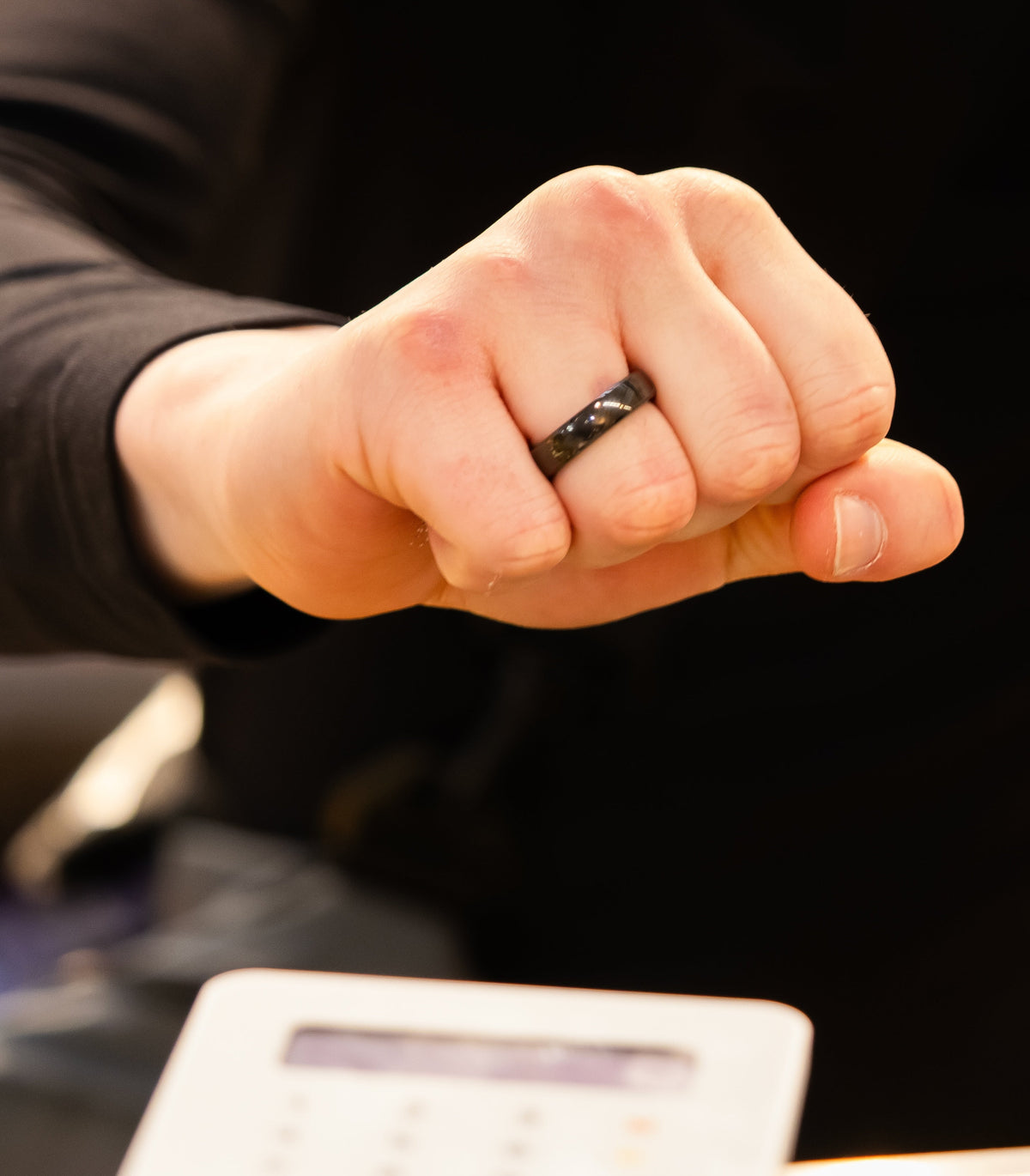
It never needs charging. Our rings have no battery. There is nothing to plug in, nothing to remember overnight, no slow degradation of cell capacity over three years of use. The ring is powered by the field of the terminal you tap it against. This is the single biggest practical difference between a payment ring and a smart ring that happens to offer payments, and it is why we do not chase step counts or sleep scores. A payment ring should do one thing and be ready every time.
It is invisible. No screen, no light, no clasp, no cable. It reads as jewellery, because that is what it is.
Behind that simplicity sits some genuinely careful work. Our tokenisation partner is Fidesmo, so your card details are never stored on the ring itself, only a token that is useless to anyone who finds it. Our gemstone bracelet range was qualified stone by stone for radio-frequency compatibility at 13.56MHz, which is why you will find tiger eye, obsidian, labradorite, lapis lazuli and rose quartz in the range, and why you will not find magnetite or pyrite. Metal-bearing stones look beautiful and kill the signal. We tested rather than guessed.
We also solved the problem that stops most people buying a ring as a gift. Ring sizing is guesswork, and guesswork is a returns problem. Our gift voucher pairs with an AI camera sizer, so the recipient sizes themselves and we ship the right ring first time.
- Tiger Eye Payment Bracelets
- Tokenised Biometric Payment Cards
- Payment Charms for Chain Bracelets
The thinking person's choice
If you want a payment ring, you have options. Some of them are backed by well-funded consumer brands with strong design and a lot of marketing budget.
What we offer is different. A company that has been trading since 2009 and does not need your purchase to survive. Certification with both major card schemes. A banking group in Europe spending its own money to advertise us. Tokenisation handled by a specialist. A ring that will never ask to be charged. And a business whose commercial success directly funds financial inclusion for people who need it most.
That is not the loudest pitch in the category. It is, we think, the one that holds up under scrutiny.
RingPay. From Money Carer.
Részesedés:
What Is the Best Payment Ring? An Honest Guide from Someone Who Builds Them
The bank that gave away the future: why CIB Bank and Visa have changed the direction of payments in Hungary